I Want to Be an Art Therapist for Children
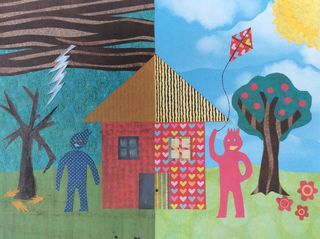
Source: © 2014 "Before and After Fine art Therapy" C. Malchiodi
In "Child'south Play: How Play Therapy Works," Casado-Frankel observes that parents often ask about the effectiveness of play therapy as a course of treatment and say, "But it's just play!" Fine art therapy oftentimes attracts the same question and a like response—"But it'south merely arts and crafts!" Like play therapy is non just "play," art therapy is not just "craft" or even its offset cousin, the ubiquitous coloring volume. And also like play, art created within the context of a therapeutic human relationship is not only intended to help young clients appoint in self-exploration, it also involves purposeful meaning-making through specific art making.
Kid fine art therapy is often confused with play therapy and for many proficient reasons. Play therapists introduce various art-based activities in their work with children when appropriate; similarly, art therapists who work with children include play activities [toys, puppets, props and games] to supplement fine art therapy and stimulate children's creative expression. Fine art making within the context of therapy is, all the same, a slightly unlike experience from play considering it encourages the creation of a tangible product in almost cases. Fine art therapists are besides in the business of helping children visually express and record experiences, perceptions, feelings and imagination; they capitalize on their vast knowledge of art media and arts-based approaches to raise young clients' ability to communicate through creative expression. Here is a brief overview of how and why art therapy works:
Non-Exact, Sensory-Based. By its simplest definition, art expression is a class of non-verbal communication. For children who may not be able to articulate thoughts, sensations, emotions or perceptions, information technology is one style to convey what may exist difficult to express with words. For those who have experienced abuse, information technology is one mode to "tell without talking" when they are unable or afraid to speak about specific events or feelings. It is too a sensory-based arroyo that allows the children to experience themselves and communicate on multiple levels—visual, tactile, kinesthetic and more.
Growth and Development. Fine art expressions, peculiarly drawings, provide useful data on evolution in children, especially young clients who are 10 years or younger. For example, differences in creative development tin can help u.s. empathise something nigh a child'southward emotional experiences, cognition and sensory integration—but merely up to a point, because most of what has been widely published has been derived from largely Western cultures. Despite this challenge, the currently accepted stages of artistic development, especially with younger children, are all the same generally helpful and add together valuable information not always apparent through talk therapy alone.
Cocky-Regulation. Neurobiology continues to inform mental health professionals about why specific fine art-based activities, within the context of therapy, may exist helpful to children. In particular, certain sensory characteristics of fine art making seem to be constructive in improving mood, sensory integration, and calming the trunk and mind, especially with children who accept experienced traumatic events.
Meaning-Making. Like play therapy, art therapy provides an opportunity to express metaphor through fine art expression. In fact, one of the strengths of both approaches is their ability to encourage and enhance storytelling and narratives. Storytelling about a drawing, painting, collage or construction does non accept to be literal to be therapeutic. In fact, a child who has experienced traumatic events or is challenged by an emotional disorder may only discover it possible to generate imaginative stories. With the support and guidance of the therapist, these narratives serve every bit a way to slowly and safely release disturbing or terrorizing experiences.
Kid-Therapist Connexion. Finally, creative expression on its own is not a guaranteed "cure"; like play therapy, fine art therapy is predicated upon a relationship with a helping professional. All artistic arts therapies are inherently relational therapies because they involve an active, sensory-based dynamic between practitioner and individual and emphasize the connection between kid and therapist. In this sense, art therapy can exist helpful in repairing and reshaping attachment through experiential and sensory means and may tap those early relational states that exist before words are dominant, allowing the encephalon to establish new, more than productive patterns. Any professional person who effectively applies fine art therapy principles to piece of work with children is well-versed in how to establish positive attachment, attunement and reflexive convergence, the latter referring to the experience in which ii individuals feel "felt" by each other and thus deeply understood and unconditionally accustomed. Fine art expression, like play, adds to these positive relational experiences on multiple levels involving sensory, affective and cerebral channels of communication.
- What Is Therapy?
- Observe a therapist most me
This a very cursory explanation of some of the reparative dynamics art therapy provides to children. Children's art expressions and imaginative play may seem elementary at first glance. Only equally the fields of art therapy and play therapy go on to expand cognition nigh their effectiveness, nosotros extend the possibilities for best practices with all children in need of help and healing. And while there is still a lot we do not know about exactly "how it works" when it comes to art therapy, nosotros practice know that drawing, playing and pretending are all a natural part of the "work" of children.
© 2016 Cathy Malchiodi, PhD
Visit the Trauma-Informed Practices and Expressive Arts Therapy Institute for more information well-nigh expressive arts therapy with children, adults and families and educational offerings on trauma-informed expressive arts therapy.
Source: https://www.psychologytoday.com/us/blog/arts-and-health/201601/child-art-therapy-how-it-works
0 Response to "I Want to Be an Art Therapist for Children"
Post a Comment